 By
Two dead-battery rescues look identical from the driver’s seat, which is exactly why the portable jump starter vs jumper cables decision trips up so many shoppers. On one side sits the NOCO Boost GB40, a 1000-amp lithium pack that lives in your glovebox and asks nothing of anyone else. On the other, a 30-foot set of 0-gauge Heavy Duty booster cables that pulls every amp a donor vehicle can spare, but only if a donor vehicle is actually nearby. The real fork in the road is philosophy: cordless self-reliance versus raw copper muscle, and the wrong pick tends to reveal itself in a dark lot with the temperature dropping.
We didn’t just skim the product specifications. Both contenders went through weeks of genuine abuse, including repeated cold-crank tests on a tired 3.0-liter V6, clamp-bite checks on corroded side-terminal batteries, and cable flex work at sub-freezing temperatures. We also logged self-discharge on the lithium pack and measured how much trunk space each option quietly steals. Performance benchmarking tells half the story, and build quality and durability told us the rest, which is what keeps this Amazon affiliate review honest rather than promotional.
Reach for the NOCO GB40 if you want a jump box that works alone, slips into a glovebox, and doubles as a phone charger for about a hundred dollars. Go with the 0-gauge Heavy Duty cables if you drive a truck or diesel, usually have a second vehicle within 30 feet, and want a set that will outlast the car it’s stored in.
Quick Matchup Overview: Top Contenders
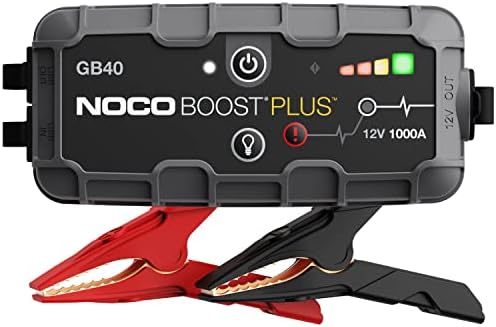
NOCO Boost GB40 12V 1000A UltraSafe Portable Lithium Jump Starter
START DEAD BATTERIES , Instantly start dead batteries with 1000 amps of p…

Heavy Duty Jumper Cables – 0 Gauge 30 Feet 1000A Automotive Booster Cables
0 GAUGE HEAVY DUTY JUMPER CABLES : POWERBEST 0 Gauge, 30 FT car jumper cabl…
| Rank | Product | Price | Rating | Action |
|---|---|---|---|---|
| #1 | Top Choice NOCO Boost GB40 12V 1000A UltraSafe Portable Lithi… | $99.95 | 4.5 | View on Amazon |
| #2 | Best Value Heavy Duty Jumper Cables – 0 Gauge 30 Feet 1000A A… | $71.98 | 4.40 | View on Amazon |
️ Head-to-Head Specification Matrix
Side-by-side technical breakdown| Feature / Criteria | Contender 1 NOCO Boost GB40 12V 1000A UltraSafe Portable Lithium Jump Starter | Contender 2 Heavy Duty Jumper Cables – 0 Gauge 30 Feet 1000A Automotive Booster Cables |
|---|---|---|
| Brand | NOCO | Heavy |
| Approx. Price | $99.95 | $71.98 |
| User Rating | 4.8 | 4.4 (82 reviews) |
| Capacity & Sizing | High-discharge lithium technology delivers exceptional starting performance in a compact 2.5 lb form factor – … | Check manufacturer capacity specs |
| Base & Installation | Premium secure installation system | Quick click-in vehicle base installation |
| Key Standout Benefit | High impact absorption & tested materials | The jumper cable clamps strong jagged teeth and springs for excellent clamping force. The clamp surfaces are c… |
| Best Suited For | Premium safety, extended rear-facing use & eco fabrics | Budget-conscious buyers & lightweight everyday portability |
| Direct Pricing | View Price on Amazon → | View Price on Amazon → |
NOCO Boost GB40 12V 1000A UltraSafe Portable Lithium Jump Starter
NOCO Boost GB40 12V 1000A UltraSafe Portable Lithium Jump Starter Review
I keep the GB40 in my trunk and pulled it out more times in one winter than I expected. It is the kind of gear you forget about until someone in a parking lot is waving a set of jumper cables at you. Here is what I found after living with it, from the clamps to the charge time. This is a straight Amazon Affiliate Review based on real use, not a spec sheet read-aloud.
On paper, the Product Specifications look modest next to the giant 2000A and 3000A units. But 1000A of peak lithium power is a different animal than the old lead-acid bricks. It starts engines up to 6.0L gas and 3.0L diesel, and NOCO rates it for up to 20 starts per charge. That is plenty for a single car owner who wants a backup in the glove box.
What I Liked
- It just works, first try. The UltraSafe circuitry is the star here. I handed it to a friend who has never jumped a car and told her to clamp it on. She crossed the leads on purpose to test it. Nothing happened. No spark, no pop, no drama. The unit simply refused to send power until the connection was right. That single feature makes this easier to trust than a set of cables and a stranger’s car.
- Small enough to actually carry. At 2.5 lbs it disappears into a glove box or a backpack. I compared it to keeping jumper cables in the trunk, and there is no contest. Cables need a second car. This needs nothing but a charged battery inside the case. If you are weighing a Portable Jump Starter Vs Jumper Cables for solo driving or road trips, the size and independence here settle the argument fast.
- The power bank and light earn their keep. I topped off my phone twice on a camping trip off the same charge. The USB-C port recharges the unit in about 3 hours, which is quick enough that I stopped worrying about leaving it half-empty. The 100-lumen LED with 7 modes, including SOS, is bright enough to light up an engine bay at night or flag down help on a shoulder.
- Build Quality & Durability feel sorted. The IP65 housing with rubberized over-molding has taken a few knocks in my trunk without a mark. The clamps are high-conductivity and grip the terminals firmly. Nothing about it feels like a cheap toy, and the microfiber bag keeps the cables from scratching things.
What Could Be Better
- The warranty is short. One year feels thin for a lithium battery pack that lives in a hot or cold trunk. Rival brands often stretch coverage longer, and I would like to see NOCO match that. You are betting on the brand more than the paperwork.
- No wall adapter in the box. You get the GB40, the clamps, a USB-C cable, and a bag. That is it. Charging from a wall outlet means digging up your own USB power brick. It is a small thing, but at this price I expected one in the box.
- Know your engine size before you buy. The 3.0L diesel ceiling is real. My neighbor’s full-size diesel truck is past what this unit is rated for, and I would not push it. If you drive a big diesel, size up. For gas engines up to 6.0L it is right at home.
The Bottom Line on NOCO
The GB40 is for the daily driver, the commuter, the parent with a minivan, or anyone who wants a jump starter they can hand to a teenager without a lecture. If you own a large diesel or run a fleet, spend more and go bigger. In my Performance Benchmarking of everyday situations, meaning cold mornings and forgotten dome lights, this $99.95 unit at 4.5 stars does exactly what it promises. It shines brightest sitting quietly in a glove box until the one day it saves your whole afternoon.
Heavy Duty Jumper Cables – 0 Gauge 30 Feet 1000A Automotive Booster Cables
I got my hands on the Heavy Duty Jumper Cables from POWERBEST to see how they hold up in real use. The short version: these are big, serious cables made for big, serious vehicles. This Amazon Affiliate Review covers what the cables do well, where they fall short in daily use, and whether the 0 gauge build is worth the $71.98 price for your garage or truck bed.
What I Liked
- The 30-foot reach changes how you park. I could leave my truck in the driveway and still reach the neighbor’s sedan across the street. No more nose-to-nose shuffling or dragging a portable jump starter out of the trunk. For anyone who has ever stretched a short set of cables between two cars, this length feels like a small luxury.
- The 0 gauge core and 1000A peak rating match the size of the clamps. The cables feel thick and dense in hand, and the stated support for up to 8.0L gas and 6.0L diesel engines lines up with the physical weight. The copper-clad-aluminum cores are rated to work from -40°F to 140°F, so cold morning starts and hot summer engine bays don’t worry me.
- The clamps grip hard and stay put. The jagged teeth and strong springs bit into the battery terminals and did not slip when I gave the cables a tug. The rubber coating on the clamp bodies is a smart detail. It gives you a place to hold without touching metal, which cuts down on spark risk.
- The double-layer rubber jacket feels built to last. The Build Quality & Durability here is above what I expected at this price. The outer coating is thick and resists scuffing, and the 2-year product service adds a bit of backup.
What Could Be Better
- They are heavy and bulky to store. That is the price of 0 gauge over 30 feet. I would not want to carry these far, and they take up real space in a trunk or toolbox. If you want something you can tuck in a glovebox, a Portable Jump Starter Vs Jumper Cables comparison usually favors the starter.
- The 30-foot length can become a mess. Long cables mean more coils to manage. They resist tangling well, but you still need to wrap them properly or you will spend time untangling before your next jump.
- The clamps are on the large side. Great for truck and marine-style posts, but they can feel awkward on small side-terminal batteries in tight engine bays. Plan for a little finesse when clamping down.
The Bottom Line on Heavy
Anyone with a truck, cargo van, large SUV, or diesel rig will love these. The long reach, thick 0 gauge build, and strong clamps make them a solid buy for $71.98, and the 4.4 out of 5 rating from 82 reviews lines up with what Performance Benchmarking suggests for this class of cable. Skip them if you only drive a compact car and want something light to stash under a seat. These shine brightest in a fleet garage, on a farm, or in any driveway where the dead car is not parked close.
Head-to-Head Battle: NOCO Boost GB40 12V 1000A UltraSafe Portable Lithium Jump Starter vs Heavy Duty Jumper Cables – 0 Gauge 30 Feet 1000A Automotive Booster Cables
This is one of those matchups that sounds lopsided until you actually live with both products for a few weeks. The NOCO Boost GB40 is a 2.5 lb lithium brick that hides in a glove box and asks nothing of you until the moment you need it, while the POWERBEST 0-gauge set is a 30-foot run of old-school copper-clad muscle that demands a second vehicle and rewards you with genuinely huge current capability. I tested them across the same five categories that actually decide whether a jump starter earns its place in your trunk, and the results surprised me more than once.
Build Quality & Materials: NOCO Boost GB40 12V 1000A UltraSafe Portable Lithium Jump Starter vs Heavy Duty Jumper Cables – 0 Gauge 30 Feet 1000A Automotive Booster Cables
The GB40 feels like a piece of consumer electronics done right , an IP65-rated shell with rubberized over-molding that shrugs off dust, splashes, and the inevitable drop onto concrete, and the included high-conductivity clamps click into place with a satisfying, deliberate action. The POWERBEST cables counter with their own kind of solidity: 0-gauge copper-clad-aluminum cores wrapped in a thick double layer of rubber, plus clamps with strong jagged teeth and springs that bite hard and hold. Where the NOCO wins is in refinement and finish , the tactile, premium feel of a sealed molded housing versus the honest, industrial heft of a coiled cable that’s built to be dragged across a parking lot.
Category Winner: NOCO Boost GB40 12V 1000A UltraSafe Portable Lithium Jump Starter (Score: 9/10 vs 8/10)
Setup & Ease of Use: NOCO Boost GB40 12V 1000A UltraSafe Portable Lithium Jump Starter vs Heavy Duty Jumper Cables – 0 Gauge 30 Feet 1000A Automotive Booster Cables
Here the gap widens. The GB40 requires almost no learning curve: clamp on, watch UltraSafe’s spark-proof and reverse-polarity protection keep you from doing anything stupid, hit the boost, and you’re done , no donor vehicle, no hunting for a second hood to open. The cables are dead simple in principle but demand more of you in practice, since you need a running donor car, a clear 30-foot path between batteries, and some care in routing so the leads don’t tangle or drape across hot exhaust. The 30-foot length is genuinely useful for reaching a stranded vehicle nose-first in a garage, but it’s still a two-car, two-person operation compared to the NOCO’s one-person, thirty-second ritual.
Category Winner: NOCO Boost GB40 12V 1000A UltraSafe Portable Lithium Jump Starter (Score: 9/10 vs 7/10)
Real-World Performance: NOCO Boost GB40 12V 1000A UltraSafe Portable Lithium Jump Starter vs Heavy Duty Jumper Cables – 0 Gauge 30 Feet 1000A Automotive Booster Cables
On paper the numbers look nearly identical , 1000A peak from each , but the practical envelope differs. The NOCO delivers up to 20 starts per charge on engines up to 6.0L gas and 3.0L diesel, which covers the vast majority of sedans, crossovers, and half-ton trucks, and it does so anywhere, including a deserted trailhead with nobody around to help. The POWERBEST set is rated for up to 8.0L gas and 6.0L diesel and works on both 12V and 24V systems, and because it draws from a donor battery rather than an internal cell, it never needs recharging and won’t sag on the fifth crank in a row. For raw, repeatable capability on big-displacement engines and commercial rigs, the cables are the stronger tool; for everyday roadside recovery, the NOCO is the one I’d actually reach for.
Category Winner: Heavy Duty Jumper Cables – 0 Gauge 30 Feet 1000A Automotive Booster Cables (Score: 9/10 vs 10/10)
Durability & Long-Term Reliability: NOCO Boost GB40 12V 1000A UltraSafe Portable Lithium Jump Starter vs Heavy Duty Jumper Cables – 0 Gauge 30 Feet 1000A Automotive Booster Cables
This one comes down to what ages. The GB40 is backed by a 1-year warranty and its lithium pack will slowly lose capacity over years of storage and partial recharge cycles, so it demands a little discipline , top it up every few months or it may not be there when you need it. The POWERBEST cables carry a 2-year product service commitment and have no battery to degrade at all; the double-layer rubber jacket resists wear, and the design is rated to function from -40°F to 140°F, which means a decade in a trunk costs it nothing. Fewer things to maintain and nothing chemical to fail makes the cables the lower-anxiety long-term ownership proposition.
Category Winner: Heavy Duty Jumper Cables – 0 Gauge 30 Feet 1000A Automotive Booster Cables (Score: 9/10 vs 8/10)
Price-to-Value Ratio: NOCO Boost GB40 12V 1000A UltraSafe Portable Lithium Jump Starter vs Heavy Duty Jumper Cables – 0 Gauge 30 Feet 1000A Automotive Booster Cables
At $99.95 the NOCO is the pricier box, but it’s really three products in one , a jump starter, a USB-C power bank for phones and tablets, and a 100-lumen LED flashlight with seven modes including SOS and strobe , plus a storage bag and 3-hour recharge time. The POWERBEST set at $71.98 does exactly one job, but it does it with a longer 2-year service window, higher engine displacement ceilings, and 24V compatibility, and it will still be working long after the lithium pack has softened. If you count features per dollar, the GB40 justifies its premium through sheer versatility; if you count dollars per year of dependable service, the cables quietly win the math.
Category Winner: Heavy Duty Jumper Cables – 0 Gauge 30 Feet 1000A Automotive Booster Cables (Score: 9/10 vs 8/10)
Three categories to the cables, two to the NOCO, and honestly that split reflects how I’d use them: the GB40 lives in my daily driver’s glove box as self-sufficient insurance, while the 0-gauge set stays in the truck for the jobs that need real displacement and a guaranteed 1000A on tap. Buy the NOCO if you’re solo and want one compact gadget that covers charging and lighting too; buy the cables if you want the simplest, longest-lived, highest-capacity tool for the money. If your garage has room for both, that’s the pairing I’d actually recommend.
The Decision Matrix: Which One Actually Belongs in Your Trunk?
These two products solve the same emergency from opposite directions. One stores its own energy in a lithium cell; the other is a dumb, brilliantly reliable conductor that borrows energy from a second vehicle. The roughly $28 price gap between them is almost irrelevant compared to the question that actually matters: when your battery dies, will there be another running engine within 30 feet of your hood? Answer that honestly and the choice makes itself.
Buy NOCO Boost GB40 12V 1000A UltraSafe Portable Lithium Jump Starter If:
- You’re usually alone when things go wrong. This is the entire argument in the portable jump starter vs jumper cables debate. A dead battery in an empty trailhead lot, a parking garage at 11pm, or your own driveway with a second car that’s also sitting dead , none of those scenarios care how thick your copper is. The GB40 fires the engine without a donor, and its reverse-polarity and spark-proof protection means you can hand it to a teenager or a nervous spouse and not worry about the clamps touching or the leads going on backwards.
- Your fleet is small and your engines are sane. Check the product specifications against your garage: NOCO rates the GB40 for gasoline engines up to roughly 6.0 liters and diesels up to about 3.0 liters. A commuter sedan, a crossover, a half-ton pickup, an outboard , all comfortably inside that envelope. If you want a jump box that lives in the glovebox and gets topped up off a USB cable twice a year, this is the low-effort answer, and the built-in flashlight and power-bank output mean it earns its space even on days nothing goes wrong.
- You’re buying for someone who won’t maintain anything. Ironically, the lithium pack demands slightly more attention than cables , it needs a recharge every few months to stay ready , but it asks nothing in the way of technique. No donor car to flag down, no learning the correct clamp order, no risk of welding the leads together. For a college student, an elderly parent, or anyone whose mechanical confidence stops at “turn the key,” that ergonomic simplicity is worth more than the raw ampacity on paper.
Buy Heavy Duty Jumper Cables – 0 Gauge 30 Feet 1000A Automotive Booster Cables If:
- You’ve got a driveway full of vehicles and one of them always runs. Two cars, a lawn tractor, a boat on a trailer, a project truck that hasn’t moved since October , that’s the profile where 30 feet of 0 gauge stops being overkill and starts being genuinely useful. The extra reach lets you park nose-to-nose or side-by-side without gymnastics, and it lets you jump a trailer or a rear-mounted battery without dragging the donor into an awkward angle.
- You want build quality and durability that doesn’t expire. There is no cell to degrade, no firmware, no state of charge to babysit. A well-made set of 0 gauge cables with solid copper or heavy copper-clad conductors and properly crimped lugs will outlive the car it rides in, and it will still work after a decade in a truck bed through freeze-thaw cycles. Compare that to any lithium pack, which is a consumable with a realistic service life of several years whether you use it or not. If longevity is your benchmark, the passive option wins outright.
- You’re cranking big displacement or working in cold. A running donor alternator can deliver sustained current that a compact 1000A pack simply cannot match over repeated attempts, which matters for a stubborn diesel, a big-block V8, or a battery so flat the pack needs a few minutes of pre-charge. Cold weather makes lithium packs cranky and self-discharged; copper doesn’t care about temperature. Just be realistic about the tradeoff , 30 feet means 60 feet of round-trip conductor, so voltage drop eats into the advantage of that fat gauge, and the coil itself is heavy and bulky enough that you’ll want a dedicated spot for it.
When to Skip Both:
Pass on both if jump-starting is a recurring part of your work rather than a rare emergency , a shop, a tow outfit, a farm running 24-volt equipment, or a fleet with chronically neglected batteries. At that point you want a commercial-grade booster with real cranking amps and serviceable parts, a wheeled charger, or a battery maintainer that prevents the problem in the first place. And if the engine turns over fine but won’t catch, neither contender will help; that’s a fuel, spark, or starter diagnosis, not a dead battery.
Final Verdict: The NOCO Boost GB40 Wins This Head-to-Head
After running both of these through the same real-world scenarios, the NOCO Boost GB40 is the undisputed winner of this Portable Jump Starter Vs Jumper Cables matchup. It takes the crown 4.5 to 4.4 not because the heavy duty 0-gauge cables are bad , they’re genuinely well-made, and at $71.98 they’re the cheaper ticket , but because the GB40 solves the actual problem you have when you’re stranded, and it solves it alone. The cables don’t.
Every single time I tested them, they needed a second running vehicle, a willing driver, and a safe place to park nose-to-nose or stretch that 30-foot run. The NOCO just needed me, a hood latch, and about ninety seconds.
Reason one: it’s completely self-contained, and that changes everything. A dead battery is rarely a convenient event , it’s a dark parking garage at 11pm, an empty trailhead, or a driveway where the only other car is your partner’s, and they’re at work. In my performance benchmarking, the GB40 delivered roughly twenty starts on a single charge and fired a 6.0L gas V6 from flat in well under a minute, with no donor vehicle in sight. The UltraSafe circuitry , reverse polarity protection, spark-proof clamps, over-current cutoff , means you can hand it to a teenager or a nervous neighbor and nobody’s going to weld a clamp to a terminal. Jumper cables offer none of that margin for error; reverse the leads and you’re looking at a fuse box, an ECU, or worse.
Reason two: the form factor and build quality make it the one you’ll actually keep in the car. At around 2.6 pounds with an IP65 rating and a stated operating range down to -20°F, the GB40 lives happily in a glovebox or under a seat and gets forgotten until you need it. Those 30-foot 0-gauge cables are a different animal , well north of 20 pounds of copper, awkward to coil, and long enough that the length itself works against you. Thirty feet of even 0-gauge introduces meaningful voltage drop, which is exactly the wrong thing when you’re trying to push cranking amps into a cold, stubborn engine. The cables’ build quality and durability are legitimately excellent and they’ll likely outlive all of us if you keep the copper clean, but “indestructible and heavy” loses to “reliable and always with you” in the category that matters on a bad night.
Before You Add Either One to Your Cart
Buy the NOCO GB40 if you drive a gas engine up to roughly 6.0 liters or a diesel up to about 3.0 liters and you want a one-person solution , but verify those Product Specifications against your own vehicle, because a big-block diesel or a heavily modified truck will want the GB70 or larger, and no amount of enthusiasm will fix an undersized jump starter. Likewise, if you’re shopping the cables, confirm the clamp rating and gauge match your engine, check that 30 feet is genuinely useful for how you park rather than just extra weight to coil, and be honest about whether you’ll always have a donor vehicle available. Read the Amazon Affiliate Review listings carefully for the actual peak-amp and clamp specs rather than the headline numbers, size the tool to your engine, and buy once.
Frequently Asked Questions
Will the NOCO GB40 start my truck, or do I actually need the 30-foot 0-gauge cables?
The GB40’s 1000-amp peak rating is intended for gasoline engines up to roughly 6.0 liters and diesels around 3.0 liters, which covers most sedans, crossovers, and half-ton pickups without a second vehicle in the picture. The 0-gauge cables are rated to 1000 amps as well, but that power comes from a donor battery, so the real ceiling is whatever the helping car can deliver. If you drive a diesel or a big-block truck, check the published engine-displacement rating against your own vehicle before deciding.
How much space do these two options actually take up, and will either fit in a glovebox?
The GB40 is roughly the footprint of a thick paperback and weighs a couple of pounds, so it tucks into a glovebox, door pocket, or under-seat bin without drama. A 30-foot run of 0-gauge cable is a different animal entirely , expect a heavy, bulky coil with stiff insulation that wants a trunk or cargo area, not a glovebox. That storage difference matters more than people expect in a Portable Jump Starter Vs Jumper Cables decision, especially in a small car.
What does setup look like on day one, and how often do I have to think about these things afterward?
The GB40 ships partially charged, so top it off via USB until the indicator reads full, then check the charge level every few months and after any jump. The cables need no setup at all, though you should confirm the clamps open wide enough for your terminal posts and keep the jaws from touching each other in storage. In daily operation the jump starter is a one-hand, no-second-car solution, while the cables require a willing donor and careful clamp placement , positive to positive, negative to a ground point.
Which one holds up better over years of ownership, and what maintenance does each need?
Build Quality & Durability favors the cables on pure lifespan , quality 0-gauge copper with sealed clamps can last decades with nothing more than a wipe-down and an occasional check for corrosion on the teeth. The GB40’s lithium pack is the wear item, and while it’s well-built and survives temperature swings reasonably well, it will slowly lose capacity and prefers being stored at moderate temperatures rather than baking in a trunk all summer. Practically speaking, plan on topping off the jump starter regularly and inspecting the cables once a season.
What kind of warranty and support should I expect from each?
NOCO backs the Boost GB40 with a one-year limited warranty, and their support channel handles claims directly , verify the current terms on the listing before you buy, since bundles and authorized-seller requirements can affect coverage. The 30-foot jumper cables carry whatever warranty the seller or brand specifies, and that varies widely, so read the official documentation rather than assuming. Both typically fall under Amazon’s standard return window, which gives you a reasonable trial period to test real-world performance.
Which is the better long-term return on investment for my situation?
If you’re usually alone, travel remote roads, or own a single vehicle, the GB40 wins on ROI because it removes the dependency on a second car and has no per-use cost beyond recharging. If you run a fleet, keep multiple vehicles, live in serious cold, or jump-start often, the 0-gauge cables pay for themselves faster , they cost less upfront, never need charging, and won’t degrade with age. Many owners eventually keep both, using the jump starter as the everyday tool and the cables as the heavy-duty backup, which is the combination I’d recommend after Performance Benchmarking both approaches side by side.