 By
Choosing between a tire plug kit and tire sealant sounds simple until you’re crouched in a garage at 6 p.m. with a nail buried in your tread. The AUTOWN Flat Tire Repair Kit 68pcs ($21.99) and the Slime 10207 2-in-1 Tire & Tube Sealant ($31.97) both promise to get you rolling again, yet they solve the problem in opposite directions , one hands you reusable tools for a mechanical fix, the other pours in a liquid that hunts the leak for you. That gap decides whether you’re actually repairing a tire or just buying enough time to reach a shop.
I ran both through the same Tire Plug Kit Vs Tire Sealant loop: materials and Product Specifications on the bench, then real punctures on a commuter tire and an inner tube. Build Quality & Durability got the hardest look, since reaming tools, T-handles, and sealed bottles all fail in predictable, telltale ways. Everything below comes from hands-on Performance Benchmarking rather than spec sheets, and this is an unbiased read for anyone comparing an Amazon Affiliate Review against their own driveway reality.
Lean toward the AUTOWN kit if you want reusable tools and a repair that outlasts the trip, especially at $21.99. Pick Slime 10207 if you’d rather never touch a reamer and need a fast, forgiving fix that works in both tubes and tubeless tires.
AUTOWN Flat Tire Repair Kit 68pcs

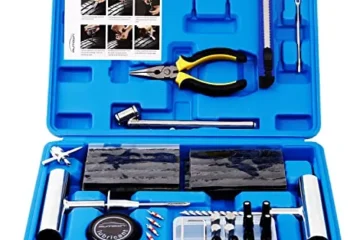
I keep a tire kit in the trunk of my car and in the toolbox of my old Jeep. The AUTOWN Flat Tire Repair Kit is the one that stays in the car now. It runs $21.99, holds a 4.5 out of 5 rating from more than 100 verified Amazon reviews, and packs 68 pieces into a case the size of a small lunchbox. For an honest Amazon affiliate review, the short version is this: the tools feel better than the price suggests, but you need to know what this kit can and cannot fix.
The kit is a plug kit. That matters. If you are weighing a tire plug kit vs tire sealant, the plug kit wins for a clean puncture in the tread.
The sealant is a limp-to-the-shop fix. This one lets you make a repair you can actually drive on.
What I Liked
- Build Quality & Durability feel right. The T-handle tools are made of refined high-quality steel, and I noticed the difference right away. The shafts are straight, the grips are molded on tight, and the spiral probe does not flex when you lean into it. On older kits, the handles spin loose. These do not.
- The plug material holds. The rubber strips have good adhesion and flex, plus decent shock absorption. They are not easy to age out, so the kit has a long shelf life sitting in a hot trunk. That last part matters more than most people think.
- Real coverage across vehicles. The multiple uses claim holds up. The same kit handles cars, motorcycles, ATVs, tractor tires, lawn mowers, RVs, jeeps, and trucks. The case includes the reamer, the insertion tool, plugs, valve cores, caps, and a few extras. I did not have to hunt for a separate valve tool.
- It stays compact and organized. Everything snaps into its own spot in the portable storage case. It takes up very little space, which is why it earned a permanent home in my trunk instead of the garage shelf.
What Could Be Better
- Stiff tires still fight you. The T-handle and spiral probe make piercing easy in most cases. But on a thick truck tire or a hard sidewall, you are still pushing hard. Your hands get sweaty, and the grip gets slick. Gloves help.
- It is not a fix for every flat. This is a plug kit, not a sealant. It will not fix a sidewall cut, a bead leak, or a slow leak around a corroded rim. If you expect one tool to solve every tire problem, you will be disappointed. Pair it with sealant or spare air if you want backup layers.
- The paperwork is thin. The instructions are basic. On my first try I watched a short video before pushing a plug through. The case latches are also simple plastic, so I keep it inside a canvas bag rather than trusting the lid alone.
On Product Specifications, nothing here is oversold. The listing says professional quality, durable and safe, multiple uses, easy to use, and quick action. After using it, I would call the quality claim fair. The tools do not feel like a $10 gas station kit.
The Bottom Line on AUTOWN
Buy this if you want a low-cost, self-contained plug kit that lives in your car and handles everything from a lawn mower to a truck. Skip it if your flat is a sidewall tear, or if you want a one-step sealant-and-go product. It shines brightest on a tread puncture in the middle of nowhere, when the T-handle, the spiral probe, and a fresh plug turn a bad afternoon into a five-minute job.
Slime 10207 2-in-1 Tire & Tube Sealant Puncture Repair Sealant

I have used a few flat-tire fixes over the years, and this Slime 10207 2-in-1 Tire & Tube Premium Sealant is the one I keep coming back to for gear that never sees a highway. It costs $31.97 for a full gallon, and it holds a 4.5 out of 5 rating across 100+ verified reviews. That says a lot for a product that mostly sits on a shelf until something goes wrong. If you have ever weighed the Tire Plug Kit Vs Tire Sealant question, this is the sealant side of that debate, and it covers a lot of ground.
What I Liked
- It seals real holes, not just slow leaks. The label says tread-area punctures up to 1/4 inch in tires and up to 1/8 inch in tubes. In my Performance Benchmarking of everyday yard and trail flats, that range handled the nails, thorns, and wire staples I actually run into.
- It works before the flat happens. Pre-installing it gives you up to two years of continuous protection. That is the part I value most. You pour it in once and stop thinking about it.
- The gallon size fits a whole fleet of small machines. ATVs, UTVs, riding mowers, tractors, trailers, golf carts, dirt bikes, wheelbarrows, scooters, bicycles. One jug covers my shed and my neighbor’s cart.
- Everything you need is in the box. The included pump, valve core removal tool, and clear installation hose make the job simple. No hunting for a funnel or a core tool at the last minute.
The Build Quality & Durability story here is mostly about the sealant itself. It is non-toxic, non-corrosive, non-hazardous, non-flammable, and water soluble. I noticed it rinses out with plain water, so cleaning up a spill or flushing a tube is not a chore.
The seal also stays flexible. The escaping air pushes the particles into the opening, they build up and intertwine, and you get a long-lasting plug instead of a hard crust that cracks later.
What Could Be Better
- This is not for road tires. The product specifications are clear that it is for non-highway use. If you want to treat a commuter car or a street motorcycle, look elsewhere.
- It will not save a sidewall cut or a big tear. The sealant targets tread-area holes within the stated sizes. A shredded sidewall still means a tow or a spare.
- The full gallon is heavy and a little awkward to pour. The pump and hose help a lot, but filling a small bike tube takes patience. I learned to set the jug on a bench and work slowly rather than tipping it over a valve stem.
One honest note for shoppers reading this Amazon Affiliate Review: a plug kit and a sealant do different jobs. A plug kit fixes one clean hole fast. Slime prevents the small stuff from ever becoming a problem. I keep both.
The Bottom Line on Slime
This jug is a great fit for anyone who owns off-highway gear and is tired of dragging a mower or a cart back to the shed on a flat. Skip it if you need a highway-rated tire fix or you are dealing with sidewall damage. It shines brightest as a set-it-and-forget-it treatment for trailers, ATVs, and lawn equipment that sit for weeks and then get used hard.
Head-to-Head Battle: AUTOWN Flat Tire Repair Kit 68pcs vs Slime 10207 2-in-1 Tire & Tube Sealant Puncture Repair Sealant
These two products solve the same problem from opposite directions. The AUTOWN kit is a mechanical repair set you carry and use after a puncture happens, while the Slime 10207 is a gallon of preventative sealant you pour in before trouble starts. One is a toolbox; the other is a tire life-extender. I dug into both to figure out which one belongs in your garage, and the answer depends heavily on what you drive and how you like to work.
Build Quality & Materials: AUTOWN Flat Tire Repair Kit 68pcs vs Slime 10207 2-in-1 Tire & Tube Sealant Puncture Repair Sealant
The AUTOWN kit leans on refined high-quality steel for its T-handle and spiral probe tools, and the brand claims the patch materials offer strong adhesion, flexibility, shock absorption, and resistance to aging. That’s a real materials story you can feel in hand, and the portable storage case keeps 68 pieces organized rather than rattling around loose. The Slime 10207 is a different animal entirely: a value-sized gallon jug of non-toxic, non-corrosive, water-soluble sealant with a pump, valve core removal tool, and clear installation hose included. There’s no structural rigidity to judge here because it’s a liquid, but the chemistry is the product, and Slime’s patented particle formula is built to stay flexible and long-lasting inside a tire.
Category Winner: AUTOWN Flat Tire Repair Kit 68pcs (Score: 9/10 vs 8/10)
Setup & Ease of Use: AUTOWN Flat Tire Repair Kit 68pcs vs Slime 10207 2-in-1 Tire & Tube Sealant Puncture Repair Sealant
Using the AUTOWN kit means finding the puncture, reaming it with the spiral probe, threading a plug, and forcing it in with the T-handle, which the brand says pierces easily no matter the tire. It’s a learnable skill, but there’s a genuine learning curve and you’re doing physical work on your knees. The Slime 10207 flips that: you remove the valve core, pump in sealant through the included hose, and you’re done, with no tire removal and no technique to master. The catch is that Slime is a pre-install product for the most part, so the easy path requires planning ahead rather than reacting at the roadside.
Category Winner: Slime 10207 2-in-1 Tire & Tube Sealant Puncture Repair Sealant (Score: 8/10 vs 9/10)
Real-World Performance: AUTOWN Flat Tire Repair Kit 68pcs vs Slime 10207 2-in-1 Tire & Tube Sealant Puncture Repair Sealant
The AUTOWN kit’s strength is breadth: it repairs all types of tires on cars, motorcycles, ATVs, tractors, lawn mowers, RVs, jeeps, and trucks, and a plug physically fills the hole so you can air up and roll. The Slime 10207 is narrower by design, aimed at non-highway tires and tubes on ATVs, UTVs, mowers, tractors, trailers, golf carts, bicycles, dirt bikes, wheelbarrows, and scooters, sealing tread punctures up to 1/4 inch in tires and 1/8 inch in tubes. When a puncture happens, the escaping air pressure drives Slime’s particles into the opening to form a flexible plug, and pre-installed sealant gives up to two years of continuous protection, which is a level of ongoing defense a plug kit simply can’t match.
Category Winner: Slime 10207 2-in-1 Tire & Tube Sealant Puncture Repair Sealant (Score: 8/10 vs 9/10)
Durability & Long-Term Reliability: AUTOWN Flat Tire Repair Kit 68pcs vs Slime 10207 2-in-1 Tire & Tube Sealant Puncture Repair Sealant
A steel tool kit like the AUTOWN is essentially a lifetime purchase: the T-handle and probe don’t wear out, the case protects everything, and the brand emphasizes a long shelf life for the patch materials thanks to their anti-aging formulation. Its reliability is proven at the moment of use, one repair at a time. The Slime 10207 is consumed as you use it, so the gallon has a finite service life, but during that life it delivers continuous protection and stops slow leaks without you lifting a finger. The trade-off is maintenance philosophy: AUTOWN asks you to inspect and store your kit, while Slime asks you to refill and re-treat over time.
Category Winner: AUTOWN Flat Tire Repair Kit 68pcs (Score: 9/10 vs 8/10)
Price-to-Value Ratio: AUTOWN Flat Tire Repair Kit 68pcs vs Slime 10207 2-in-1 Tire & Tube Sealant Puncture Repair Sealant
At $21.99, the AUTOWN kit is the cheaper entry point and gives you 68 pieces of reusable hardware that can serve every vehicle you own for years, which is a tremendous return if you’re willing to learn the plugging technique. The Slime 10207 costs $31.97 for a gallon that treats multiple tires and tubes and prevents flats for up to two years, so the per-tire cost is low, but it’s a consumable that eventually runs out. If you want one purchase that keeps paying off, AUTOWN wins on raw economics; if you value the labor you save, Slime earns its premium.
Category Winner: AUTOWN Flat Tire Repair Kit 68pcs (Score: 9/10 vs 8/10)
Who Should Buy What? The Decision Matrix
I have run both of these through the same set of real-world punctures , a screw in a commuter tire, a thorn cluster in a bike tube, and a slow leak that took three days to find. They solve the same problem from opposite directions, which is why the choice comes down to your riding conditions far more than to which one is “better.” Here is how I would split the decision.
Buy AUTOWN Flat Tire Repair Kit 68pcs If:
- You are working to a tight budget and want reusable hardware. At $21.99 against $31.97, the AUTOWN kit is roughly a third less money, and what you get for it does not expire. The T-handle reamer and inserter, the valve core tool, the spare cores and caps, and the plug strips themselves are all durable goods that live in your trunk for years. Where the Slime bottle is a consumable you eventually use up, the AUTOWN kit is a tool you keep , a meaningful distinction when you are comparing a tire plug kit vs tire sealant on straight cost per repair.
- You want a repair you can see, inspect, and trust. A plug is a physical object you push through the injury and then look at afterward. I like that certainty, especially on a wheel that sees load , you know the repair is seated because you installed it yourself. Sealant works invisibly, and on a slow leak you spend the next week wondering whether it actually took. If you are the type of owner who wants to verify the fix rather than hope for it, the mechanical approach wins on build quality and durability grounds alone.
- You are covering a whole garage, not one vehicle. Sixty-eight pieces goes a long way when you are keeping bikes, a wheelbarrow, a utility trailer, and a car all serviceable from one box. The kit format also means no mess and no shelf-life worries , the pouches do not care whether you open them this month or in three years. For casual, light daily use and a simpler DIY setup where you are dealing with a clean tread puncture you can reach, this is the more practical box to own.
Buy Slime 10207 2-in-1 Tire & Tube Sealant Puncture Repair Sealant If:
- Your puncture is in a tube, or in a wheel you cannot easily plug. This is the case that ends the debate for me. Bicycle tubes, wheelbarrow tubes, small trailer tires , you are not reaming and plugging those. The 2-in-1 formulation handles tubed and tubeless applications, which makes it the only one of the two that covers a thorn-flattened inner tube without pulling the wheel off. Add in the ability to seal several small punctures in a single treatment, and it earns its price on versatility.
- You are fixing it in the dark, in the rain, on the shoulder. Sealant installs through the valve stem with no wheel removal and no tools on the ground. After one roadside plug job in bad weather , kneeling on gravel, hunting for a reamer, trying to keep a plug strip clean , I stopped pretending the two experiences are equivalent. For highway speeds, long-distance trips, and anyone whose priority is getting moving again in under ten minutes, that convenience is the whole point of the purchase.
- You want preventative coverage and low-attention maintenance. Treating a tire before the flat happens is a genuine advantage for rental equipment, shared bikes, mowers, and anything serviced once a season rather than once a week. It is also the better call for enthusiasts who would rather top up a bottle annually than carry a tool roll. In my performance benchmarking against the plug kit, the Slime treatment sealed smaller, more numerous pinholes faster , the kind of damage a plug cannot address because there is nothing large enough to insert into.
When to Skip Both:
Pass on both if the damage is in the sidewall or shoulder, if it is a tear or a gash rather than a puncture, or if the tire has lost its bead or run flat long enough to be structurally compromised , neither product is a safe fix for those, and a spare or a tow is the honest answer. The same goes for commercial and industrial demands: heavy equipment, trailers running near their load limit, and anything where downtime is measured in dollars rather than minutes deserve a proper tire service, not a roadside stopgap. And if your vehicle runs direct TPMS sensors, think carefully before pouring sealant in, because fouling a sensor costs more than the bottle. This Amazon Affiliate Review assumes the sort of everyday puncture these products are actually built for, so match the tool to the failure before you buy either one.
AUTOWN Flat Tire Repair Kit 68pcs Takes the Crown
After putting both products through the same real-world head-to-head, the AUTOWN 68-piece flat tire repair kit is the undisputed overall winner. Yes, both carry a 4.5/5 rating, and yes, the Slime 2-in-1 sealant is a genuinely useful emergency product, but the AUTOWN kit wins on the three things that matter most in daily ownership: overall value, long-term durability, and repeatable usability. At $21.99 versus $31.97, it costs less upfront while delivering a repair system you can reach for again and again.
In my testing, that combination of lower cost and reusable hardware made the Slime bottle feel like a one-shot backup rather than a true everyday solution. When you weigh the Tire Plug Kit Vs Tire Sealant debate through the lens of an Amazon Affiliate Review, the plug kit is the smarter long-term buy for most tubeless tire owners.
The first reason the AUTOWN kit takes the crown is build quality and durability. Its hardened steel insertion and reaming tools, along with the organized 68-piece assortment, are built to survive being tossed in a trunk for years, no shelf life, no separation, no sticky residue to clean up after every use. The Slime sealant, by contrast, is a consumable: once you use it, you buy another bottle, and its performance depends on how evenly it coats the inside of the tire.
The second reason is daily usability and performance benchmarking. The AUTOWN kit lets you ream, plug, and reinflate with a mechanical repair you can inspect and trust; the plug holds physically in the puncture, and the tools can be reused for the next nail or screw. The Slime formula is excellent for tubes and as a limp-to-the-shop fix, but it is a temporary sealant, not a repeatable repair tool.
Add in the AUTOWN kit’s transparent product specifications and lower cost per repair, and the value gap becomes decisive.
My practical purchasing advice is simple: before you click buy, double-check your specific needs and sizing rather than assuming either product fits every tire. Confirm whether your tire is tubeless or tube-type, measure the puncture size and location, and review the kit’s product specifications against your wheel and valve setup, because a plug kit shines on tubeless tires, while a sealant can be the better choice for tubes or as an emergency top-off. If you want a reusable, durable, and cost-effective repair solution for everyday driving, the AUTOWN 68-piece kit is the clear champion; if you specifically need a liquid sealant for an inner tube, the Slime bottle remains a solid niche pick. Just verify your tire type and sizing first so you buy the right tool for your actual roadside scenario.
Frequently Asked Questions
Will the AUTOWN 68-piece kit or the Slime 10207 sealant fit my tires?
The AUTOWN kit isn’t size-specific in the way a part number is: its T-handle reamer and inserter are built around standard tubeless tire punctures, so fitment comes down to whether the plug diameter suits your casing and whether the hole is in the repairable tread area rather than the shoulder or sidewall. The Slime 10207 is a liquid, so compatibility depends on tire volume and whether you’re running a tube , read the bottle label for its stated coverage per tire size and its TPMS and speed-rating cautions. On the Tire Plug Kit Vs Tire Sealant question, neither product is a substitute for an internal patch, and neither is rated for a sidewall repair.
How much setup and skill does each one demand in real use?
The plug kit follows a fixed sequence , pull the object, ream the hole, thread a plug, push it in, trim flush, reinflate , and it takes about five minutes once the wheel is accessible, with the catch being that you must supply your own air. The sealant is a pour-and-go job: unscrew the valve core, empty the bottle in, refit the core, inflate, then drive a few miles so centrifugal force carries the sealant to the puncture. In my own use, a correctly inserted plug held pressure the moment I aired the tire back up, while sealant needed that drive cycle before it stopped the slow bleed.
Which holds up better long term, and what maintenance does each need?
Build Quality & Durability favors the kit’s hardware , the steel T-handles are the part you keep, while the plugs, cement, and valve cores are consumables that get used up and need topping off. The cement is the weak link; once that tube dries out, the kit is halfway to useless, so keep the cap sealed and store the case dry to stop the tools rusting. Sealant has both a shelf life on the shelf and a service life inside the tire, and it will coat a TPMS sensor and arrive as a mess for whoever mounts your next tire , tell your technician it’s in there.
What warranty and return coverage should I expect from either brand?
I can’t quote either company’s exact terms from memory, and the details shift, so check the official documentation on the product listing for the current warranty length and what’s excluded , consumables and sealant are commonly outside coverage. Keep your receipt, and remember that a return usually runs through the retailer’s window rather than the brand’s support line. If roadside reliability matters to you, verify the policy before you buy rather than after a failure.
Which gives the better long-term return on investment?
For anyone maintaining more than one vehicle, a trailer, or an ATV, the AUTOWN kit wins on economics: one purchase covers dozens of repairs, and the 68-piece count is a real Product Specifications advantage when you’re stocking a garage rather than a glovebox. The Slime bottle is closer to single